Sunday, September 1, 2013

Michael Gillespie, The theological origins of modernity

My son, Christopher, just sent me an email today from New York where he lives, in which he relates (I'm quoting by permission):
I finished [Michael Allen] Gillespie's The Theological Origins of Modernitylast night. It was overall a very enjoyable read.

He turns the conventional reading of the Enlightenment (as reason overcoming religion) on its head by explaining how the humanism of Petrarch, the free-will debate between Luther and Erasmus, the scientific forays of Francis Bacon, the epistemological debate between Descarte and Hobbes, were all motivated by an underlying wrestling with the questions posed by nominalism, which dismantled the rational God-and-universe of scholasticism and introduced (by the Franciscans) a fideistic God-of-pure-will born of their concern that anything less than such would jeopardize God's omnipotence -- subsequent intellectual history is in Gillespie's reading a grappling with the questions of free will and divine determinism; Protestantism involved at its core fidiestic, denying of free will will in order to preserve God's absolute power. However, this in turn culminated in an ambivalence about salvation. If God simply wills whom to save, human action then has no real merit or significance (Luther's "sin boldly"). Gillespie's chapter on the Erasmus-Luther was among the most interesting in bringing this out. Also fascinating was his discussion of Descartes and Hobbes -- the latter usually depicted as an atheist and his philosophy as chiefly political -- as sincerely religious, and revealing the underlying metaphysical concerns behind his thought. And so Gillespie says, even in modern times, we are bequeathed with a similar wrestling with modernity's political ambitions to increasing freedom and the inability to reconcile this with science's inherent determinist worldview. Likewise, in the post-9/11/ confrontation with Islam (which makes a brief appearance at the end) we are again confronted with the pure will and absolutism of Islam which sees the West's assertion of "individual autonomy" / free will as a challenge to God's omnipotence, for whom our only response is obedience.
From his blog review, Against the Grain, Christopher quotes the fundamental thesis of Gillespie from the book:
...the apparent rejection or disappearance of religion and theology in fact conceals the continuing relevance of theological issues and commitments for the modern age. Viewed from this perspective, the process of secularization or disenchantment that has come to be seen as identical with modernity was in fact something different than it seemed, not the crushing victory of reason over infamy, to use Voltaire’s famous term, not the long drawn out death of God that Nietzsche proclaimed, and not the evermore distant withdrawal of the deus absconditus Heidegger points to, but the gradual transference of divine attributes to human beings (an infinite human will), the natural world (universal mechanical causality), social forces (the general will, the hidden hand), and history (the idea of progress, dialectical development, the cunning of reason)....

That the deemphasis, disappearance, and death of God should bring about a change in our understanding of man and nature is hardly surprising. Modernity ... originates out of a series of attempts to construct a coherent metaphysic specialis on a nominalist foundation, to reconstitute something like the comprehensive summalogical account of scholastic realism. The successful completion of this project was rendered problematic by the real ontological differences between an infinite (and radically omnipotent) God and his finite creation (including both man and nature).
Christopher cites Lee Trepanier's concise summary of the intellectual path Gillespie takes to demonstrate his thesis (University Bookman), delving into the thought of Petrarch and the significance of the debates between Luther and Erasmus, Descartes and Hobbes as they grappled with the theologic implications of nominalism.

Apart from finding the last chapter "a bit rushed and inconclusive" (the post-9/11 spectre of Islam makes a cursory appearance at the end, but isn't adequately elaborated), he calls Gillespie's revisionist intellectual history of modernity and "immensely informative" and "provocative challenge to the conventional, secular reading of history." Sounds interesting. Read more on Christopher's blog >>

Friday, November 16, 2012

Christopher Ferrara, Liberty, The God that Failed

Christopher Shannon, "A Declaration of Catholic Independence" (Crisis Magazine, October 30, 2012):
G.K. Chesterton once described America as a “nation with the soul of a church.” Many have wrongly interpreted this statement as Chesterton’s way of saying that America was a Christian nation, or that Americans were especially pious and devout people. Chesterton meant something rather different, and not especially complementary. America is like a church in the sense that it has often understood citizenship in terms of assent to a creed. One becomes an Englishman or Frenchman through history, through coming from a family that has lived in a particular place for generations. In contrast, one can theoretically become an American simply by assent to certain abstract principles, the American creed. Chesterton’s characterization of America as a creedal nation came to mind as I passed an election sign for the Romney-Ryan ticket that read, “Believe in America.” What could this possibly mean? Is America a god? What precisely are we supposed to believe in? In a word, liberty. And make no mistake about it, liberty is a god.

That, at least, is the argument that Christopher A. Ferrara makes in his important and timely new book, Liberty, the God That Failed: Policing the Sacred and Constructing the Myths of the Secular State, from Locke to Obama.The title references the 1949 work The God that Failed, a famous collection of essays by ex-communists describing their disillusion with the utopian ideology of communism. Liberal and conservative American political thinkers share a common characterization of communism and fascism as irrational, secular religions against which the American political tradition stands as a model of reason and moderation. It is just such a conceit that Ferrara sets out to expose as a delusion. At a time when the American bishops are calling on Catholics to defend the American tradition of religious liberty against state coercion, Ferrara argues that religious liberty itself has been the main ideology through which the modern state has sought to redefine and control religion. This is a difficult and challenging argument, one that goes against the common sense of American political thinking. It is an argument based on a very different kind of common sense that comes from traditional Catholic understandings of the public nature of Church authority.

Thursday, August 9, 2012

Origin's doctrine of the soul

A comprehensive analysis of the
theological anthropology of one of
the early church's finest theologians

Become Like the Angels
Origin's Doctrine of the Soul


Benjamin P. Blosser

Origen of Alexandria (c. 185-245), a catechist, presbyter, and confessor of the ancient Church was a foundational figure in the establishment of early Christian theology. Today he is commonly referred to as "the first Christian theologian" and is widely known as a master of biblical exegesis, rational inquiry, and spiritual formation. Yet his legacy remains somewhat ambiguous in part because of the posthumous condemnation of certain propositions from his works. Become Like the Angels explores Origen's legacy and, in particular, his teachings about the origin, nature, and destiny of the human person. By way of a historical critical approach, Benjamin P. Blosser discusses the influence of Middle Platonic philosophy on the human soul and then compares it with Origen's teaching.

This study finds that, while Origen was highly aware of Middle Platonic speculations on the soul and does borrow extensively from their vocabulary, he never accepts their underlying, philosophical assumptions and is in fact subtly critical of Middle Platonic theories of the soul. His anthropology remains from first to last a biblical, Christian, and even mystical one, the fruit of a remarkable effort to synthesize faith and reason in the ancient Church.
“An ambitious and very well researched book on the way in which Origen deals with a fundamental issue in ancient philosophy—the position, state, and function of the soul in a living being. It is a topic at the core of all anthropological and cosmological thinking in Late Antiquity. In elegant, lucid prose, Blosser takes the reader gently through the minefield of previous scholarship and presents a very clear and skillful exposition of Origen as religious philosopher.”
—John A. McGuckin, professor of Byzantine church history, Columbia University, and editor of The Westminster Handbook to Origen of Alexandria

Benjamin P. Blosser is associate professor of theology at Benedictine College where he teaches courses in church history, ecclesiology, and New Testament studies.  He received his Ph.D. in historical theology from the Catholic University of America.

Sunday, July 10, 2011

"The Devil Knows Latin"

Don't you just love that quote from Monsignor Ronald Knox? You know, the one made famous by E. Christian Kopff in his delightful book, The Devil Knows Latin: Why America Needs the Classical Tradition(2001):
Ronald Knox, a wise and witty Catholic priest, when asked to perform a baptism in the vernacular, responded with what his biographer Evelyn Waugh described as “uncharacteristic acerbity”: “The baby does not understand English and the Devil knows Latin” (Kopff xv).
The background story, of course, is that a minor exorcism is part of the traditional Catholic baptismal ritual, involving not only holy water, but exorcised salt and holy chrism oil. According to the Catholic Encyclopedia, St. Cyril of Jerusalem (ca. AD 313 – 386) gives a detailed description of baptismal exorcism (in Procatechesis 14). Hence Msgr. Knox's statement: "The Devil Knows Latin."

Most of Kopff's message about the joys of Latin and importance of classical education in this book will be greeted by your average American run-of-the-shopping-mall philistines with about as much joy as an invitation to attend the Traditional Latin Mass. But never mind the philistines, what matters is whether the claim is true. I remember reading some biographies of 19th-century and early 20th-century British writers about ten years after I began teaching college, and feeling sorely deprived educationally, even with a doctorate in hand. These guys were studying Greek and Latin and reading Virgil's Aeneid and Plutarch's Lives in the original when they were junior high school age.

It may well be true that we don't need to know Latin or have a classical education to be saints; but it may not only help us stave off the barbarous philistinism of our blithely high-tech yet historically oblivious new dark age, but may even help us along the path to sanctity if it happened to help us discover the abundant legacy of the Church's saints, resources for growth in holiness, and rich spiritual heritage of Mater Ecclesia. I would even argue that a classical education has considerable value in itself as a protoevangelium or praeparatio evangelium. Certainly St. Augustine found it so, who, in his Confessions, attests to the help provided him by the Neo-Platonists in overcoming the obstacles to faith produced by his earlier Manichaeism. Further still, Plato's dialogues provide some of the finest rebuttals of the kind of sophomoric relativism that thrives in the postmodernist environments around most contemporary universities. You can't be a relativist and be open to the Gospel.

Thursday, June 23, 2011

The Political Problem of Religious Pluralism


Christopher Oleson reviews Thaddeus Kozinski, The Political Problem of Religious Pluralism: And Why Philosophers Can't Solve It

To the typical inhabitant of a modern liberal democracy, the title of Thaddeus Kozinski's intriguing new book will probably sound a little puzzling, inasmuch as, within contemporary democractic culture, religious pluralism is not generally understood to be a "political problem." On the contrary, for the democratic soul, religious pluralism seems to be more a positive good, something to be protected and celebrated, rather than "solved" or overcome. One's religious commitments would have to be "extreme" and thus "anti-democratic" to take issue with liberalism's positive affirmation of religious diversity, for it is one of democratic modernity's greatest achievements to have crafted institutional arrangements that allow for the easy co-existence of various religious groups both with one another and with the overarching liberal political order.

* * * * * * *
Secular democratic modernity can only claim not to have a religious pluralism problem because it has already implicitly solved this problem by subtly emasculating traditional religious identity

* * * * * * *

One of the many insights of Thaddeus Kozinski's valuable contribution to the on-going conversation about the relationship between Faith and politics is to articulate with precision how secular democratic modernity can only claim not to have a religious pluralism problem because it has already implicitly solved this problem by subtly emasculating traditional religious identity and establishing, under the false veil of political neutrality, institutional arrangements charged with theological and metaphysical significance.

Thus, only by becoming enculturated to re-interpret religious belief in such a way that it can have no substantive implications for the social and political order, and correspondingly, by becoming miseducated to not notice the tacit establishment of a quite partisan sense of the good, freedom, and selfhood, do the citizens of secular democracies think that they have a neutral social order that need not view religious pluralism as politically problematic. For those whose religious creed is not merely an emotional accoutrement, this situation is obviously deeply troublesome, for the logic of secular liberalism, as Kozinski makes clear, would force the believer to treat his Faith commitments as merely therapeutic preferences of an autonomous self.

Clarifying this situation and working towards articulating a solution to it which is at once both honest about its principles, coherent in working them out, and politically expressive of the truth and ultimate happiness of man is the task that Kozinski sets himself in his book. He does this by successively engaging the thought of three influential and progressively illuminating political philosophers. John Rawls, Jacques Maritain, and Alasdair MacIntyre. Rawls serves as the quintessential philosophical voice of secular democratic liberalism, Maritain as the exponent of a Catholic hybridization of Thomistic political philosophy and modern democratic ideals, and MacIntyre as the most penetrating philosophical critic of liberal modernity and advocate of a local Thomistic politics of the common good against the bureaucratic nation-state.

Of the three, Kozinski is by far the most sympathetic to MacIntyre. Nevertheless, even his proposal falls short in Kozinski's eyes, for MacIntyre's vision of small communities of virtue does not quite attain to the level of truly political existence, remaining as it does, Kozinski claims, too local in its aspirations. More importantly for Kozinski, MacIntyre's thought problematically remains at the level of mere philosophy. Studiously avoiding the role of theologian, MacIntyre deprives himself of the resources of political theology, and thereby fails to affirm the necessity of a public recognition of divine revelation and Magisterial teaching as the most propitious conditions for a stable and morally healthy political state. As Kozinski's subtitle indicates, philosophy as such can offer little or no light on how to move a community of seriously diverse worldviews to a unified political order of virtue and human happiness. Only the eventual achievement of a confessionally Catholic state, Kozinski concludes, can overcome the limitations of political philosophy in general, and liberal modernity in particular.

Sunday, May 8, 2011

Liturgy and personality

I remember reading somewhere how Dietrich von Hildebrand, after converting to the Catholic Faith, used to run enthusiastically down the street, coattails flying, to be on time for daily Mass. He loved everything about his newfound religion. As much as anything else, he loved its liturgy.

In fact, he even wrote a book entitled Liturgy and Personality,about the “healing power of formal prayer” -- the power of liturgy to profoundly form and positively shape personality. Far from furnishing us with mere training wheels until we "mature" into more personal and spontaneous prayers "from the heart," formal liturgical prayer is actually the superior form of prayer, according to von Hildebrand. The key is to enter into the prayer of the Church, to make it one's own, to "pray the Mass," as St. Pope Pius X used to say, and to live it.

Formal liturgy -- so staid and “impersonal,” and even “oppressive” in the eyes of so many today -- is actually set forth in its proper meaning as the “source and summit” of our prayer life as Catholics, the place where we encounter our Lord and our God, see where we belong in His Kingdom and, in the process, learn who we are meant to be. In coming to know our God through the Church's liturgy, we come to know ourselves.

An Editor’s note in the latest edition of the book states that "Liturgy and Personality concerns the essence of the liturgy rather than the details of any particular liturgy,” and so urges the reader “to use von Hildebrand’s numerous liturgical examples to discover the gist of his arguments demonstrating the personality-forming power of the Liturgy,” so that these points can then “be related, where appropriate, to comparable elements in today’s Liturgy.”

It is no small point, however, that Liturgy and Personality was first published in 1932 in German: the Mass von Hildebrand loved, and through which he encountered the Lord, was the traditional Latin Mass of the Roman Rite -- the one most Catholics and others today would experience as something prima facie alien, if not alienating, including its "impersonal" Latin and the priest's "back turned to the people." This is the Mass -- this one -- to which he would fly down the street with his open coat billowing behind him!

It's enough to make any sane person wonder, is it not? But then, what is sanity, liturgically speaking? Is it the product of liturgical committees? Remember the joke about the difference between a liturgist and a terrorist? You can negotiate with the terrorist.

First and foremost, von Hildebrand was a Catholic philosopher, and his books on ethics and value-theory are substantial and profound. In the latter half of his life, however, after moving to the United States and after the Second World War, he increasingly turned the attention of his formidable mind to matters of the Church. For him, these were matters of the heart; and he was especially concerned with developments in the Church in the modern post-war world. Many of these developments he found troubling -- modernism, secularism, relativism, dissent, immorality -- and, above all, some of the experiments and innovations he lived to see in the Church's sacred liturgy.

Related:

Sunday, November 21, 2010

Michael Davies: Book Review of Pope Paul's New Mass

Tridentine Community News (November 21, 2010):
Now that the stream of newsworthy events from the last several weeks is slowing down, we can return to the topic of pioneering Extraordinary Form apologist Michael Davies. [For Part I, see "Michael Davies - Part 1 of 2 - Background," Musings, September 26, 2010]

First published in 1980, Pope Paul's New Mass is part of a trilogy of books, the others being Pope John's Council and Cranmer's Godly Order. Its 663 pages are written in much the same style as, and share some of the content of, other Davies works. It is thus a good starting point for understanding his point of view. “PPNM” was one of the first books to detail the step-by-step liturgical changes that were enacted between 1964-69, the transition period between the Tridentine Mass and the Novus Ordo. It contains chapters describing the evolution of various practices which have been well-documented elsewhere and which will not be rehashed here. More uniquely, PPNM discusses Vatican documents which eliminated the Prayers at the Foot of the Altar, established the abbreviated formula for distributing Holy Communion, the option to receive Communion under Both Kinds, Concelebration, Children’s Masses, and so forth. It is enlightening to realize that the continual stream of liturgical change conditioned the faithful for the most major change yet to come, the imposition of the significantly modified New Rite of Mass in 1969. Approximately 40 documents not frequently discussed nowadays are analyzed, such as 1967’s Tres Abhinc Annos abolishing many of the genuflections and signs of the Cross in the Mass. In some cases, the entire document text is provided in an appendix.

Davies provides ample evidence that intense lobbying and electioneering by a handful of prelates from Germany and France, along with Vatican-designated point man for liturgical reform Archbishop Annibale Bugnini, pushed through these changes and particularly the creation and adoption of the Novus Ordo. This is popular knowledge among those interested in liturgical history, but Davies provides quotes from Bugnini and others proving that was actually the case. Davies also provides numerous quotes from bishops of the era, from the United States and England in particular, who had misgivings about the effect the changes would have on the faith lives of their flocks. The atmosphere was far from one of unanimity.

Davies cites evidence that the reduction, and in some cases the elimination, of language referring to the Holy Mass as a sacrifice was due to a push to make the Mass more palatable to Protestants. He presents a detailed analysis of Eucharistic Prayer II, the Offertory, and other reworded prayers and rubrics as examples of intentionally ambiguous language which can be viewed with acceptance by Protestants as well as Catholics. In conjunction he points out the vocabulary changes (e.g.: “celebrant” to “presider”) and the elimination of “negative” sentences within Scripture passages employed in the readings at Mass.

A chapter is devoted to the General Instruction of the Roman Missal and its follow-on Foreword, the rubrics for and introductory section to the altar missal. There was a surprising amount of dissension over its language, resulting in significant modifications having to be made between the 1969 and 1970 versions. As Davies writes, “What precedent is there in the history of the Church for a sacramental rite needing to have a Foreword written to justify its orthodoxy within one year of its publication?” (p. 306)

The book is filled with memorable snippets such as the following: “The police did not need to be called to Catholic churches each Sunday to hold back the hordes of lapsed Catholics whose faith had been rekindled at the prospect of saying the ConfĂ­teor in English.” (p. 92) Nevertheless, PPNM should be judged primarily on the basis of the thought-provoking facts it presents. Regardless of one’s liturgical proclivities, PPNM’s plethora of quotes from Vatican documents, articles, and interviews, amply footnoted, make the reader wonder just what the actual motivations were to impose the changes. Was it true scholarship? This seems unlikely considering all of the changes imposed in such a brief period of time, in an era before electronic communication made collaboration and discussion feasible. Was it a power play to control the liturgy by pushy individuals in an era (the 1960s) where change of all sorts appeared good? Why was making the Mass more appealing to Protestants more important than, for example, appealing to the Orthodox? One is left with the impression that the liturgical changes, and especially their vernacular translations, were rushed through because a door was open that might not be open much longer. Consider how quickly the first English translation of the Ordinary Form appeared in 1969. A mere seven years earlier, Vatican II had not yet even begun. The same thing would be far less likely to happen today, when the Internet would make such a process, and its principal actors and motivations, public knowledge rapidly. Consider that the new English translation of the Ordinary Form has been under the public microscope throughout its entire, over-seven-year process of creation.

There is much to say about the Extraordinary Form that is positive in nature, and our editorial philosophy has been to draw that attractiveness to the fore. Pope Paul’s New Mass admittedly covers some controversial territory with a more negative tone than we like. However, we believe that knowledge of Michael Davies’ significant contributions to the repopularization of the Extraordinary Form, as well as his historical assertions, is an important part of arriving at an intellectually full understanding of the Tridentine Mass as it is celebrated in the world today.

Tridentine Masses This Coming Week

Mon. 11/22 7:00 PM: Low Mass at St. Josaphat (St. Cecilia, Virgin & Martyr)

Tue. 11/23 7:00 PM: Low Mass at Assumption-Windsor (St. Clement I, Pope & Martyr)
[Comments? Please e-mail tridnews@stjosaphatchurch.org. Previous columns are available at www.stjosaphatchurch.org. This edition of Tridentine Community News, with minor editions, is from the St. Josaphat bulletin insert for November 21, 2010. Hat tip to A.B.]

Saturday, October 2, 2010

Banished Heart redivivus!

From a reader who said he tracked down a copy a couple years back when the few remaining were in Australia, notice of this timely reprint:
Banished Heart: Origins of Heteropraxis in the Catholic Church,T&T Clark Studies in Fundamental Liturgy (Edinburgh: T&T Clark, October, 2010).
It's available from Pro Multis for $35.95, but from Amazon for $25.26 and free one-day shipping for the next 17 hours and 16 minutes.

[Hat tip to J.M.]

Monday, August 30, 2010

The New Catholics

[Note: this review was written around 1990.]

Dan O'Neill, ed., The New Catholics: Contemporary Converts Tell Their Stories,with a Foreword by Walker Percy (Crossroad, 1989, pp. xv + 187; $8.95 paperback). Reviewed by Philip Blosser, Associate Professor of Philosophy, Lenoir-Rhyne College.

At a recent conference at the Franciscan University of Steubenville, a special luncheon was arranged to allow converting Protestant pastors to discuss the problems involved in carrying on their lives as new Roman Catholics. This remarkable phenomenon is just one indication of the apparently growing series of defections to Rome from evangelical and mainstream Protestantism ranks over recent years. Wishing to satisfy my curiosity about the matter, about two years ago I picked up Dan O'Neill's book, The New Catholics, and began reading. Stories such as those told by these converts could easily be multiplied many times over today, yet O'Neill's volume continues to offer a reasonably accurate cross-section of recent converts and remains a good benchmark and starting place for anyone interested in the phenomenon.

O'Neill, who is Pat Boone's son-in-law, begins his Introduction to this book by recalling how the November 7, 1986, issue of Christianity Today, the flagship magazine of America's evangelical Protestants, carried a bold feature headline on its cover: "AMERICA'S CATHOLICS: WHO THEY ARE; WHAT THEY BELIEVE; WHERE THEY ARE GOING; WHY SOME STAY; WHY OTHERS LEAVE." O'Neill comments: "As a Catholic convert from evangelical Protestant ranks, I found this focus on American Catholicism as interesting for what was not said as for what was. There might have been a final subtitle: 'WHY NON-CATHOLICS JOIN.'" This book may be considered a sampling of recent answers to that question.

Who are these converts? They are a new generation of those rediscovering and returning to ancient liturgical churches-- much as Wheaton College Professor Robert Webber describes in Evangelicals on the Canterbury Trail: Why Evangelicals Are Attracted to the Liturgical Church(1985), which he wrote shortly after he became an Episcopalian; or as former Campus Crusade for Christ staffer Peter Gilquist describes in Becoming Orthodox: A Journey to the Ancient Christian Faith(1989), shortly after he and some 200 other evangelicals joined the Greek Orthodox-- a move also made recently by Frankie Schaeffer, Jr., the son of Francis A. Schaeffer of L'Abri fame. They are part of a movement, like the Oxford movement of the last century, that is rediscovering what novelist Walker Percy calls in his Foreword "the old-new Jewish-Christian Thing, the one holy Catholic apostolic and Roman Thing." None of these converts may be as notable as Louis Bouyer, Ronald Knox, G.K. Chesterton, or John Henry Newman, who rocked the religious establishment by his conversion to Roman Catholicism in 1845. But at a time when evangelical Protestants are making inroads among Catholics, and alienated Catholics are dismissing their religious tradition as an embarrassing dinosaur, it is significant that we find the likes of Malcolm Muggeridge, Walker Percy, Thomas Howard, Sheldon Vanauken, Richard John Neuhaus, William R. Farmer, William Oddie, Scott Hahn, and a multitude of lesser-knowns swimming upstream, against a tide of disaffected Catholics, to embrace the "Roman Obedience."

Why do they convert? There is a theme, running through these accounts, of a search for spiritual identity-- a theme very much like that of Webber's and Gilquist's books. It finds expression, in some cases, as a longing for holistic spirituality, a return to mystery and sacramental reality in the experience of worship; or as a weariness with sectarian differences and a desire to embrace the whole church in all its antiquity and catholicity. Very often, it resolves in a sense of "coming home," as in the selection by Pat Boone's daughter, songwriter Cherry Boone O'Neill, which concludes with a song she composed about her union with Rome, entitled "The Family Reunion"; or as in the story of another convert who envisions his pilgrimage as a "sheep's search for a shepherd," and finds himself at last "safely in the fold of Rome, under the care of the faithful shepherd John Paul II."

In an article entitled "Mistaking Rome for Heaven" (Christianity Today, May 12, 1989), evangelical theologian J.I. Packer contrasts this sense of "coming home" among converts to Catholicism with "what makes Roman Catholics into Protestants, [which] is always convictions about God's revealed truth," and asks: "Is it healthier for a change of church allegiance to be motivated by a feeling of at-home-ness, or by a conviction of truth?" What is striking about the stories of these converts, however, is precisely their repeated accounts of struggle with "convictions of truth." If any concern runs through their stories as a major theme, it is this. Sometimes it surfaces as distress over theological modernism, with its roots in Protestant liberalism, and over hermeneutical and ecclesiastical innovations, such as those leading to the ordination of homosexuals-- or, for that matter, of women. Sometimes it surfaces in concern over the biblical imperatives of care for the poor and homeless, the sanctity of human life and marriage, and the clear-cut stance of Rome against abortion, divorce, and gay/lesbian relationships. But most often it surfaces in a desire to get beyond the sectarian contradictions and disunity in the Body of Christ and recover the authoritative orthodoxy of the ancient and apostolic Church of Rome, with its magisterium and Pope.

While this is not a book of apologetics, it is interesting to follow the snatches of theological reflection by which these converts seek to explain their moves to Rome. One recurring provocation is the distressing observation that Protestantism has spawned hundreds of sects. In his chapter, Dale Vree (editor of The New Oxford Review) cites the Oxford Encyclopedia of World Christianity (1982) as noting more than 28,000 denominations of Christianity. The tone of some writers is not always irenic. One refers to his former denomination as "a small sect that had arisen out of the heated fantasies of nineteenth-century millenarians" and reviles its concept of the Church as "this huddling together of a handful of saints who cling to their list of niggling do's and don'ts while the rest of humanity gropes blindly toward perdition."

One might wish to demur here, and point out the large body of doctrine and experience that evangelical denominations, at least, share in common. But song-writer John Michael Talbot laments, in his chapter, that the things that divide even these denominations, such as the meaning of the sacraments, are not trivial afterthoughts, but differences over the most basic things Jesus commanded us to do: "Do this in remembrance of me . . . Go . . . make disciples of all nations . . . Baptize . . . Teach them to observe all that I commanded you . . ."

This leads, in turn, to another frequent assertion: that the Protestant principles of sola Scriptura and "private interpretation" are simply inadequate. Why? A number of reasons are offered. They are powerless to prevent the multiplication of conflicting and often heretical-- interpretations, apart from an authoritative magisterium (the apostolic teaching authority of Rome). They have no basis in Scripture. Sola Scriptura violates the principle of causality-- that an effect cannot be greater than its cause: if Scripture is authoritative, then how can one deny the authority of the Church, which, gave us the Bible (through its apostles) and determined the Canon (through its early bishops)? Former Gordon College Professor Thomas Howard notes: "All the heresiarchs believed in the inspiration of the Bible, but it took the Church to say, 'This is orthodox' or 'That is heterodox.'"

Such arguments may carry little weight for those who believe that the whole Church went off the rails around the time of Constantine, or, as some 'free church' folks insist, as early as A.D. 95. Conceding this problem, Howard responds: "My difficulty with this line of thought has been settled forever by Saint Augustine's argument against the Donatists: no matter how mucked up the Church is, you can't start anything new." Such a thought simply would not have occurred to those in the early Church: "You couldn't just hive off and start something else." Acknowledging that things did get pretty mucked up, Dan O'Neill points to documented cases among the ancient Roman occupiers of Palestine of converts to Judaism, in order to show how they saw, in the face of a shattered and beaten Jewish society, that salvation was nevertheless of the Jews: "In spite of a history of wicked, faithless kings, temple harlots, arrogant and manipulative priest, and competing religious views . . . they endured circumcision and humiliation among their peers to convert. They recognized in the Law and Prophets that God was speaking through this people." O'Neill's analogy is obvious: If the Jews continued to be the people of God before the birth of Christ despite their human failings, the sins that blight the history of the Roman Catholic Church are not necessarily evidence that she is not what she claims to be or that the Holy Spirit has forsaken her.

Sheldon Vanauken (author of A Severe Mercy),in his own inimitable way, cites three arguments that convinced him "that the Holy Spirit did not leave off His guidance of the Church of Peter in matters of faith." First, not one of the wicked popes of the Avignon 'Captivity' and Great Schism altered doctrine: "In the very year that Henry VIII's obedient Parliament named him head of the English church, Pope Paul III went through the streets of Rome in sackcloth and ashes for the sins of his predecessors-- but not for their errors in doctrine." Second, the timing of the pronouncement of the long-believed-in doctrine of papal infallibility as official dogma, which came just before the unforeseeable inroads of Secularizing Modernism: "Imagine the howls from the likes of Hans Kung if it were defined today! As it is the Catholic faithful . . . know that, if need be, out of the depths of Parnassus the oracle will return into the world: the ex cathedra utterance of the Magisterium. The Church has the bomb." Third, the unforeseeable chain of events leading to the pontificate of John Paul II, the intelligent, powerful defender of the faith, "the white knight of Christendom." Vanauken admits that the Holy Spirit can guide anyone: "But does anyone really see the Holy Spirit, as opposed to the Spirit of the Age, guiding, say, the Episcopal Church-- as a church-- away from all error? Come on!"

Books and reading figure in these accounts as much as one might expect. Anticipating the "clamorous rejoinders" to everything he says, Howard interposes between his own remarks and any agitated protests the following books: John Henry Newman's An Essay On The Development Of Christian Doctrine,Ronald Knox's A Spiritual Aeneid,Louis Bouyer's The Spirit and Forms of Protestantism,Henri de Lubac's Catholicism: Christ and the Common Destiny of Man,Dom Bede Griffths' The Golden String: An Autobiography,and the Baltimore Catechism:"Demolish them before you demolish me," he writes. One finds also the usual references to writers one expects-- from Thomas Aquinas to Thomas Merton. But there are some surprises, too. A number of contemporary writers, a couple of them anthologized in this volume, figure prominently in a number of accounts, including Vanauken, Howard, and Christopher Derrick, whose father was converted by G.K. Chesterton (himself a convert). Among the most often cited was Chesterton himself. But-- as Walker Percy muses in his Foreword-- "guess who turns up most often? C.S. Lewis!-- who, if he didn't make it all the way, certainly handed along a goodly crew."

There is little here that will clear up the misgivings of evangelical Protestants about Roman dogma concerning Mary, the saints, Purgatory, and the like, and a number of things that may dismay them. Still, there is plenty to warm the heart here, and much to promote sympathy and help to overcome the old crabbed caricatures of "Papists" that prevent Protestants and Catholics from embracing one another as "separated brethren."

Saturday, August 21, 2010

Totalitarian lesbiocracy


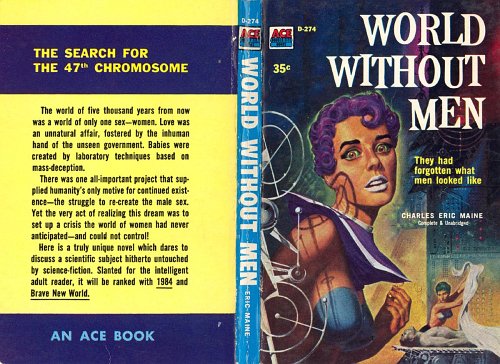
Thomas F. Bertonneau, "World Without Men: The Forgotten Novel of Totalitarian Lesbiocracy by Charles Eric Maine" (The Brussels Journal, August 17, 2010):
The blurb on the thirty-five cent Ace paperback likens Charles Eric Maine’s 1958 novel World Without Men to George Orwell’s 1984 and Aldous Huxley’s Brave New World. Ordinarily – and in consideration of the genre and the lurid cover – one would regard such a comparison skeptically. Nevertheless, while not rising to the artistic level of the Orwell and Huxley masterpieces, World without Men merits being rescued from the large catalogue of 1950s paperback throwaways, not least because of Maine’s vision of an ideological dystopia is based on criticism, not of socialism or communism per se nor of technocracy per se, but rather of feminism. Maine saw in the nascent feminism of his day (the immediate postwar period) a dehumanizing and destructive force, tending towards totalitarianism, which had the potential to deform society in radical, unnatural ways. Maine grasped that feminism – the dogmatic delusion that women are morally and intellectually superior to men – derived its fundamental premises from hatred of, not respect for, the natural order; he grasped also that feminism entailed a fantastic rebellion against sexual dimorphism, which therefore also entailed a total rejection of inherited morality.

* * * * * * *

The crumbling Ace paperback of Maine’s novel from which I quote contains a Publisher’s Postscript. It reads in part as follows: “While the manuscript of WORLD WITHOUT MEN was being prepared for publication, the staff of Ace books were startled to see… a story in the New York Times, for Oct. 16, 1957. This told of the announcement at a meeting of a ‘planned parenthood’ society of advanced work on a ‘synthetic steroid tablet’ to be taken orally to create a limited period of sterility.” According to the Postscript, this story and one other “unexpectedly underline the credibility of Charles Eric Maine’s novel.” About Maine himself, information remains scarce. Charles Eric Maine was the penname of David McIlwain (1921 – 1981), who served in the Royal Air Force in World War Two and became a writer after the war. He seems to have published fourteen novels, most of them, to judge by their titles, in the science fiction genre. (Apart from World Without Men I have read none of them.) An early effort, Spaceways (1953) became a film under the same name the year after its publication.
[Hat tip to F.R.]

Wednesday, June 30, 2010

The "ineffible weirdness" of deformed liturgy

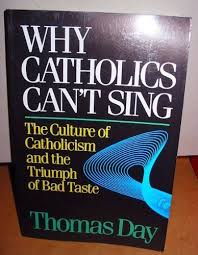
I liked Thomas Day's Why Catholics Can't Sing: The Culture of Catholicism and the Triumph of Bad Taste (New York: Crossroad, 1990) when it came out. I knew it would be entertaining, but I had no idea it would be so informative about why Catholic music and liturgy have developed the way they have in contemporary Catholicism. The book was well written, read easily and was obviously targeted at a broad audience; but it was also an education in things I did not then know about the history of the modern Church, like the various strands of Irish, Italian and German influence on liturgy in the American Church.

I recently happened across a sequel by the same author, entitled Where Have You Gone, Michelangelo: The Loss of Soul in Catholic Culture (New York: Crossroad, 1993). Dated, to be sure: that's almost two decades ago. But, to put things in perspective, my favorite college professor used to warn our class not to bother buying any book published within the last 50 years, since, he said, it hadn't yet garnered a sufficient track record to establish itself as a classic worthy of purchase. Hyperbole, of course. But he has a point. And the book looks to be a good read, perhaps a bit more playful, even, if no less serious, than his first.

Here's just a bit from his Preface to give you a taste. "This is one of the most important things to happen to the Catholic church in its entire history. You must experience it!" It sounded urgent, says the author, so he went along "to experience the experience."

The occasion, apparently sometime around the year 1980, was a Mass at a convention of a Catholic organization. Multitudes had descended upon a large cathedral for what was expected to be the sort of post-Vatican II phenomenon that would change the face of the church, if not the world, FOREVER. Multitudes eagerly awaited the experience.

Finally, music indicated that the liturgy had begun, he says, and for the next hour or more, he says he had the uncomfortable feeling that he was attending an illustrated lecture on the meaning of the word "decadent." It was like watching all his loved ones and friends disintegrate in front of him from a loathsome but unnamed disease:
Maybe it was the music: much strumming of guitars; one "contemporary" song sliding, like warm pudding, into another song of similar consistency. According to the printed Order of Service, nearly the entire liturgy would feature the songs of a famous group of "folk" musicians. Sung prayer, in other words, would also double as a demo-session, a little free advertising for the group.

Pain! Oh, the pain of listening to adolescent self-pity and self-importance in song! It would have been bearable if the congregation, caught up in the fervor of the music, had been carried along in its mighty sound, but very few people in the congregation were actually singing.
Looking for a distraction -- anything to take his mind off the group's slouching melodies, he began to look for relief in art, in the building's decorative features, which might be "read" as if they were an architectural prayerbook; which did not work too well, because the cathedral, a mountain of stone piled upon stone, "suggested a combination of a maximum security prison and a Victorian train station," though not utterly without charm. Finding that charm, however, was a little difficult since the building "had recently been subjected to extensive plastic surgery in an effort to make it look more youthful, more postconciliar." During the facelift, "the cathedral had lost some of its gingerbread ornamentation and statues that were too cloying for modern taste, but it had also lost some of its character."

His search for a prayer in architecture was interrupted, abruptly, by an amplified voice.
The presiding priest, holding a microphone now, began the Mass by telling us who he was and who the concelebrants and singers were and who we were and how wonderful it was that we had come. To soften us up even more, he made a little attempt at humor. (nobody even smiled.)

This kind of verbal intrusion, the opening warm-up monologue, is, of course, the modern post-Vatican II method for gathering Catholics together; it is supposed to make everyone feel at home -- but I am positive that the only thing everyone could feel was a rhetorical cattle-prod being shoved into the ribs. The man was forcing us to pay attention to him, and him alone. His warm-up remarks, which warmed up nobody, were really his way of establishing dominance.

A few minutes later there was a homily whose "style" seemed to blend logically with everything else. I shall never forget it.

Drifting from one off-the-top-of-his-head thought to another, the homilist sounded as if he were slipping into a coma. So many sentences ended with a pause and "y'know" that I started to count them. All of this semi-coherent mumbling was supposed to suggest his gift of intimacy and sincerity bestowed upon us, the grateful congregation; yet, at the same time, the intimacy and sincerity were also suggesting that the man had not really prepared his remarks.

It was not easy to discern exactly what the homilist was trying to say with the verbal fragments he was casually dribbling here and there, but a theme gradually emerged and it was this: "them" against "us." Out there in the world were "them," the people who just did not understand the revolution that had changed the Catholic church and the way it should worship after Vatican II. They were powerful, these reactionaries, but they would eventually be swept away. The Spirit was with "us," the authentic Christians of the post-Vatican II era, the only people who possess the true faith in Jesus Christ . . . "y'know."
Right then and there, at that very moment, he says, something forcibly struck him, something clicked ... or snapped:
I still spend a few of my waking hours trying to figure out why anybody with more than three functioning brain cells would put the label of greatness on something that was so embarrassingly shallow, why Catholic parishes by the thousands would try so hard to duplicate that same "atmosphere" of dense and banal immaturity . . . and why I reacted so badly, when I should have just walked out.

. . . I did not go to that cathedral with the idea that I should be reassured by traditional Catholicism expressing its conservatism, its orthodoxy, in traditional rituals. I certainly was not expecting to be uplifted with ceremonies, music, architecture, and preaching that were all glorious beyond description. I did, however, assume that, in a manner that an anthropologist would describe as a universal human phenomenon, I would be part of a collective, common prayer (an activity that comes in many different forms). Instead, I found myself in the middle of something very . . . weird, almost freakish, and it could not be explained away according to the ideologies of conservatism or liberalism. I realize that a High Anglican might find a Cherokee rain dance a trifle weird, just as a Presbyterian might put the same label on a Marionite Catholic liturgy from Lebanon. But the weirdness of that "experience" in a cathedral was something of an altogether different order, and I could not put my finger on it. What was the source of the problem?
The author says that his research for this book was part of his own personal quest to discover what had caused that feeling of being in the presence of "ineffable weirdness: something bizarre, neither fish nor fowl, weak, vaguely diseased." Whatever it was, he writes, "the weirdness had a life of its own and effectively blocked any encounter with theological messages that the ritual was trying to convey."

The author has no illusions about his audience:
Younger readers -- especially Catholics born after, let us say, 1960 -- are hereby forewarned. They may find it difficult to "imagine" whole sections of this book. Older Catholics will read a particular sentence and their minds might be flooded with memories (good and bad) of sights, sounds, and even smells. The younger Catholic will read the same sentence and comprehend only words printed on a page. One reason I wrote this book is to give younger Catholics a different perspective, so they could "imagine" a broader Catholic culture that most of them have never known.